


Sliding Mode Controller Based PSO MPPT for Solar PV System

Sliding Mode Controller Based PSO MPPT for Solar PV System
𝐈𝐧𝐭𝐫𝐨𝐝𝐮𝐜𝐭𝐢𝐨𝐧
Looking for a smart and effective way to improve 𝐬𝐨𝐥𝐚𝐫 𝐏𝐕 𝐩𝐞𝐫𝐟𝐨𝐫𝐦𝐚𝐧𝐜𝐞? This model demonstrates a 𝐒𝐥𝐢𝐝𝐢𝐧𝐠 𝐌𝐨𝐝𝐞 𝐂𝐨𝐧𝐭𝐫𝐨𝐥𝐥𝐞𝐫 (SMC) based 𝐏𝐒𝐎 𝐌𝐏𝐏𝐓 algorithm for extracting maximum power from a solar PV panel under different operating conditions.
Sliding Mode Controller Based PSO MPPT for Solar PV System
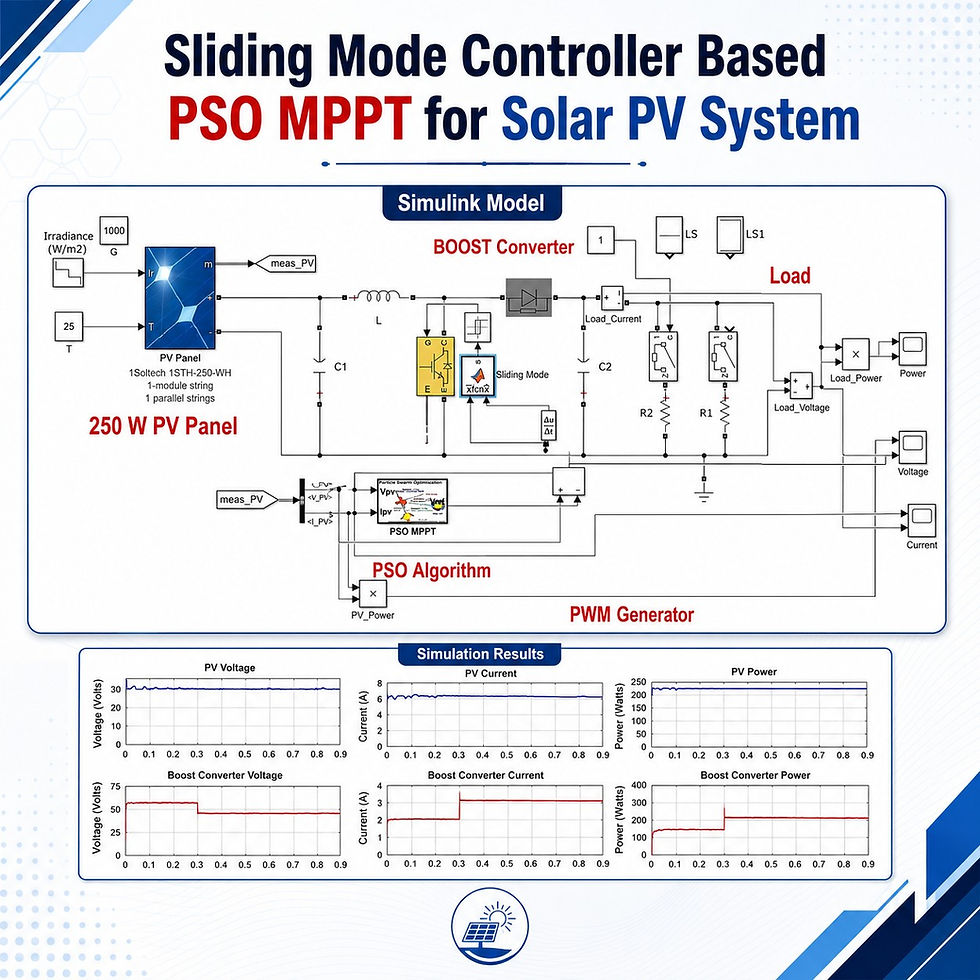
This MATLAB/Simulink-based system is useful for:
𝐒𝐭𝐮𝐝𝐞𝐧𝐭𝐬 who want to understand MPPT concepts
𝐑𝐞𝐬𝐞𝐚𝐫𝐜𝐡𝐞𝐫𝐬 working on advanced PV control methods
𝐄𝐧𝐠𝐢𝐧𝐞𝐞𝐫𝐬 interested in solar energy optimization
The model combines:
𝐏𝐒𝐎 for finding the reference maximum power voltage
𝐒𝐥𝐢𝐝𝐢𝐧𝐠 𝐌𝐨𝐝𝐞 𝐂𝐨𝐧𝐭𝐫𝐨𝐥 for robust converter switching control
𝐁𝐨𝐨𝐬𝐭 𝐂𝐨𝐧𝐯𝐞𝐫𝐭𝐞𝐫 for power modulation between PV and load
𝐒𝐲𝐬𝐭𝐞𝐦 𝐎𝐯𝐞𝐫𝐯𝐢𝐞𝐰
The overall system contains:
A 𝐬𝐨𝐥𝐚𝐫 𝐏𝐕 𝐩𝐚𝐧𝐞𝐥
A 𝐛𝐨𝐨𝐬𝐭 𝐜𝐨𝐧𝐯𝐞𝐫𝐭𝐞𝐫
A 𝐏𝐒𝐎 𝐌𝐏𝐏𝐓 controller
A 𝐬𝐥𝐢𝐝𝐢𝐧𝐠 𝐦𝐨𝐝𝐞 𝐜𝐨𝐧𝐭𝐫𝐨𝐥𝐥𝐞𝐫
A 𝐡𝐲𝐬𝐭𝐞𝐫𝐞𝐬𝐢𝐬 𝐜𝐨𝐧𝐭𝐫𝐨𝐥𝐥𝐞𝐫
A 𝐃𝐂 𝐥𝐨𝐚𝐝
PV Panel Specifications
Parameter | Value |
Panel rating | 250 W |
Open-circuit voltage | 37.3 V |
Voltage at maximum power point | 30.7 V |
Short-circuit current | 8.66 A |
Current at maximum power point | 8.15 A |
Irradiation-Based Peak Power
Irradiation (W/m²) | Peak Power (W) |
1000 | 250.2 |
800 | 199.9 |
600 | 149.6 |
400 | 98.97 |
𝐖𝐨𝐫𝐤𝐢𝐧𝐠 𝐏𝐫𝐨𝐜𝐞𝐬𝐬
The model works in a clear sequence:
The 𝐏𝐕 𝐩𝐚𝐧𝐞𝐥 generates voltage and current.
The 𝐏𝐒𝐎 𝐌𝐏𝐏𝐓 block receives 𝐏𝐕 𝐯𝐨𝐥𝐭𝐚𝐠𝐞 and 𝐏𝐕 𝐜𝐮𝐫𝐫𝐞𝐧𝐭.
It determines the 𝐫𝐞𝐟𝐞𝐫𝐞𝐧𝐜𝐞 𝐯𝐨𝐥𝐭𝐚𝐠𝐞 corresponding to the maximum power point.
This reference voltage is compared with the actual PV voltage.
The 𝐬𝐥𝐢𝐝𝐢𝐧𝐠 𝐦𝐨𝐝𝐞 𝐜𝐨𝐧𝐭𝐫𝐨𝐥𝐥𝐞𝐫 uses:
Error
Rate of change of error
The controller sends a control signal to the 𝐡𝐲𝐬𝐭𝐞𝐫𝐞𝐬𝐢𝐬 𝐜𝐨𝐧𝐭𝐫𝐨𝐥𝐥𝐞𝐫.
The hysteresis controller generates switching pulses for the 𝐈𝐆𝐁𝐓 in the boost converter.
The boost converter adjusts the operating point so the PV panel delivers 𝐦𝐚𝐱𝐢𝐦𝐮𝐦 𝐩𝐨𝐰𝐞𝐫 to the load.
𝐂𝐨𝐧𝐭𝐫𝐨𝐥 𝐒𝐭𝐫𝐚𝐭𝐞𝐠𝐲
This model uses a hybrid control approach for better tracking and robustness.
Role of PSO MPPT
Finds the 𝐨𝐩𝐭𝐢𝐦𝐮𝐦 𝐫𝐞𝐟𝐞𝐫𝐞𝐧𝐜𝐞 𝐯𝐨𝐥𝐭𝐚𝐠𝐞
Tracks the 𝐦𝐚𝐱𝐢𝐦𝐮𝐦 𝐩𝐨𝐰𝐞𝐫 𝐩𝐨𝐢𝐧𝐭 under changing irradiation
Uses PV voltage and current as inputs
Role of Sliding Mode Controller
Minimizes tracking error
Handles system variation effectively
Provides 𝐫𝐨𝐛𝐮𝐬𝐭 𝐜𝐨𝐧𝐭𝐫𝐨𝐥 even during disturbances
Role of Hysteresis Control
Converts the controller output into switching pulses
Drives the IGBT in the boost converter
Helps maintain stable converter operation
Why this control method is effective
Fast response
Good tracking accuracy
Strong performance under changing weather and load conditions
𝐒𝐢𝐦𝐮𝐥𝐚𝐭𝐢𝐨𝐧 𝐑𝐞𝐬𝐮𝐥𝐭𝐬
The system is tested in 𝐭𝐰𝐨 𝐜𝐨𝐧𝐝𝐢𝐭𝐢𝐨𝐧𝐬.
Test Conditions
Test Case | Irradiation | Temperature | Load |
Case 1 | Variable | Constant | Constant |
Case 2 | Constant | Constant | Variable |
Case 1: Variable Irradiation with Constant Load
Irradiation changes every 0.2 s
Sequence: 1000 → 800 → 600 → 400 W/m²
Observed signals:
PV voltage
PV current
PV power
Load voltage
Load current
Load power
Case 2: Constant Irradiation with Sudden Load Change
Irradiation and temperature are kept constant
Initial load is connected
An additional load is added after 0.3 s
The objective is to check whether maximum power tracking continues even during sudden load variation
Observed Performance Summary
Parameter | Observation |
PV voltage | Maintained near 30.7 V, with small variation |
PV power at 1000 W/m² | Around 250 W |
PV power at 800 W/m² | Around 200 W |
PV power at 600 W/m² | Around 150 W |
PV power at 400 W/m² | Around 99 W |
Load change response | Stable tracking maintained |
Converter/load current | Changed from nearly 3 A to 3.5 A after load addition |
Comparison: Theoretical vs Simulated Peak Power
Irradiation (W/m²) | Theoretical Peak Power (W) | Simulated Power (Approx.) |
1000 | 250.2 | 250 |
800 | 199.9 | 200 |
600 | 149.6 | 150 |
400 | 98.97 | 99 |
Key Result
The simulated power closely matches the theoretical maximum power at all irradiation levels, showing that the controller is able to 𝐬𝐮𝐜𝐜𝐞𝐬𝐬𝐟𝐮𝐥𝐥𝐲 𝐭𝐫𝐚𝐜𝐤 𝐭𝐡𝐞 𝐌𝐏𝐏.
𝐊𝐞𝐲 𝐅𝐞𝐚𝐭𝐮𝐫𝐞𝐬
𝐀𝐝𝐯𝐚𝐧𝐜𝐞𝐝 MPPT using PSO
𝐑𝐨𝐛𝐮𝐬𝐭 converter control using sliding mode technique
Works well under 𝐜𝐡𝐚𝐧𝐠𝐢𝐧𝐠 𝐢𝐫𝐫𝐚𝐝𝐢𝐚𝐭𝐢𝐨𝐧
Maintains performance during 𝐬𝐮𝐝𝐝𝐞𝐧 𝐥𝐨𝐚𝐝 𝐜𝐡𝐚𝐧𝐠𝐞𝐬
Suitable for 𝐌𝐀𝐓𝐋𝐀𝐁/𝐒𝐢𝐦𝐮𝐥𝐢𝐧𝐤 based learning and analysis
Helps users study:
PV characteristics
Converter behavior
MPPT performance
Load response
𝐀𝐩𝐩𝐥𝐢𝐜𝐚𝐭𝐢𝐨𝐧𝐬
This model can be used in:
𝐒𝐨𝐥𝐚𝐫 𝐞𝐧𝐞𝐫𝐠𝐲 𝐞𝐝𝐮𝐜𝐚𝐭𝐢𝐨𝐧
𝐌𝐏𝐏𝐓 algorithm analysis
𝐏𝐕 converter control studies
𝐑𝐞𝐬𝐞𝐚𝐫𝐜𝐡 on hybrid intelligent control techniques
𝐋𝐚𝐛 simulation and training sessions
𝐒𝐨𝐥𝐚𝐫 𝐬𝐲𝐬𝐭𝐞𝐦 performance evaluation
𝐖𝐡𝐲 𝐓𝐡𝐢𝐬 𝐌𝐨𝐝𝐞𝐥 𝐈𝐬 𝐔𝐬𝐞𝐟𝐮𝐥
Easy to understand for beginners
Practical for academic and technical learning
Demonstrates both 𝐭𝐡𝐞𝐨𝐫𝐲 and 𝐬𝐢𝐦𝐮𝐥𝐚𝐭𝐢𝐨𝐧 behavior
Shows how intelligent control improves PV efficiency
Useful for studying real-time response under dynamic operating conditions
𝐂𝐨𝐧𝐜𝐥𝐮𝐬𝐢𝐨𝐧
The 𝐒𝐥𝐢𝐝𝐢𝐧𝐠 𝐌𝐨𝐝𝐞 𝐂𝐨𝐧𝐭𝐫𝐨𝐥𝐥𝐞𝐫 based 𝐏𝐒𝐎 𝐌𝐏𝐏𝐓 for 𝐒𝐨𝐥𝐚𝐫 𝐏𝐕 𝐒𝐲𝐬𝐭𝐞𝐦 is an effective solution for maximum power extraction. By combining 𝐏𝐒𝐎-based reference generation with 𝐬𝐥𝐢𝐝𝐢𝐧𝐠 𝐦𝐨𝐝𝐞 𝐜𝐨𝐧𝐭𝐫𝐨𝐥, the system delivers strong tracking performance under both variable irradiation and sudden load changes.
For students, researchers, and engineers, this model offers a simple yet powerful platform to understand intelligent MPPT control in solar PV systems. If you want to study reliable and fast PV power tracking in MATLAB/Simulink, this is a highly useful topic to explore.


Comments