


𝐏𝐕 𝐅𝐞𝐝 𝐒𝐄𝐏𝐈𝐂 𝐂𝐨𝐧𝐯𝐞𝐫𝐭𝐞𝐫 𝐟𝐨𝐫 𝐁𝐋𝐃𝐂 𝐌𝐨𝐭𝐨𝐫 𝐁𝐚𝐬𝐞𝐝 𝐖𝐚𝐭𝐞𝐫 𝐏𝐮𝐦𝐩 𝐀𝐩𝐩𝐥𝐢𝐜𝐚𝐭𝐢𝐨𝐧

𝐏𝐕 𝐅𝐞𝐝 𝐒𝐄𝐏𝐈𝐂 𝐂𝐨𝐧𝐯𝐞𝐫𝐭𝐞𝐫 𝐟𝐨𝐫 𝐁𝐋𝐃𝐂 𝐌𝐨𝐭𝐨𝐫 𝐁𝐚𝐬𝐞𝐝 𝐖𝐚𝐭𝐞𝐫 𝐏𝐮𝐦𝐩 𝐀𝐩𝐩𝐥𝐢𝐜𝐚𝐭𝐢𝐨𝐧
𝐈𝐧𝐭𝐫𝐨𝐝𝐮𝐜𝐭𝐢𝐨𝐧
Solar-powered water pumping is an efficient solution for agricultural irrigation, livestock watering and water supply in locations where grid electricity is unavailable or unreliable.
This MATLAB/Simulink model demonstrates a PV-fed SEPIC converter connected to a BLDC motor-driven water pump. The system uses a P&O MPPT controller to extract maximum available power from the solar PV array under changing irradiation conditions.
𝐏𝐕 𝐅𝐞𝐝 𝐒𝐄𝐏𝐈𝐂 𝐂𝐨𝐧𝐯𝐞𝐫𝐭𝐞𝐫 𝐟𝐨𝐫 𝐁𝐋𝐃𝐂 𝐌𝐨𝐭𝐨𝐫 𝐁𝐚𝐬𝐞𝐝 𝐖𝐚𝐭𝐞𝐫 𝐏𝐮𝐦𝐩 𝐀𝐩𝐩𝐥𝐢𝐜𝐚𝐭𝐢𝐨𝐧
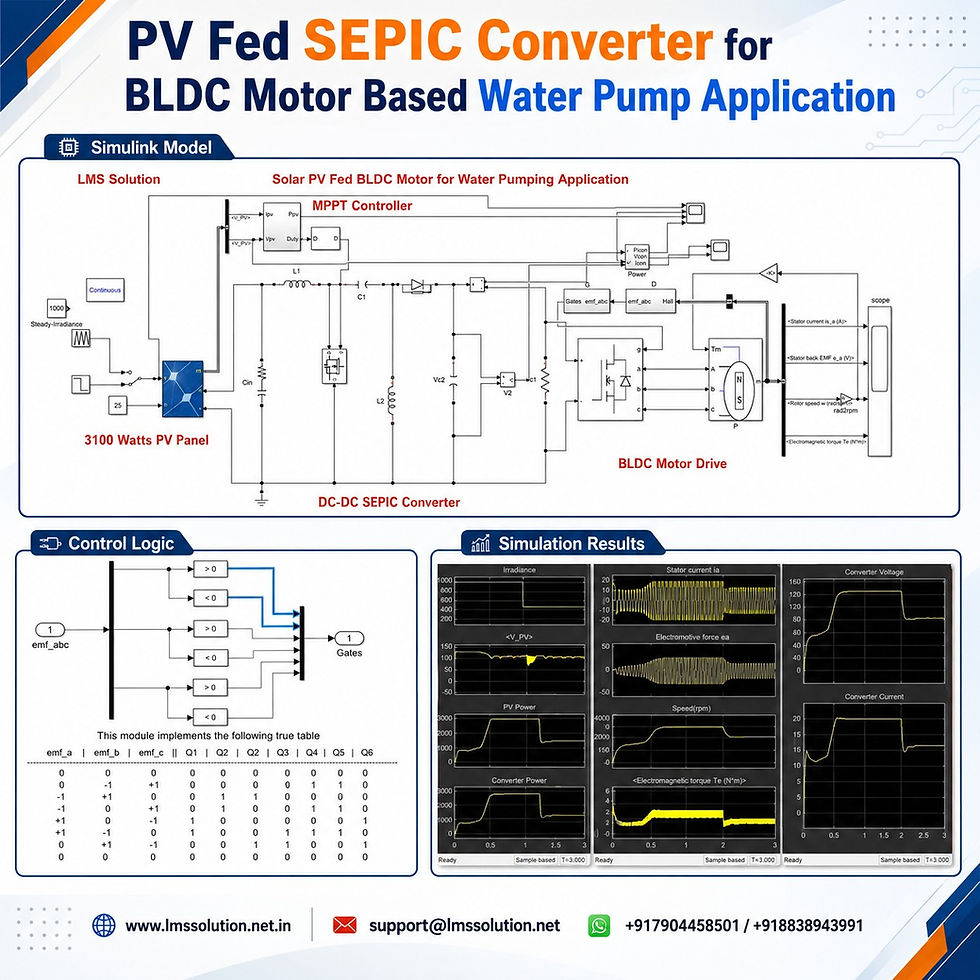
The model helps users understand:
Solar PV array configuration
P&O maximum power point tracking
SEPIC converter operation
BLDC motor electronic commutation
Water-pump load modelling
System performance under irradiation changes
𝐒𝐲𝐬𝐭𝐞𝐦 𝐎𝐯𝐞𝐫𝐯𝐢𝐞𝐰
The proposed system contains four major sections:
Solar PV array
P&O MPPT controller
DC–DC SEPIC converter
BLDC motor-based water pump
Component | Function |
Solar PV array | Converts solar irradiation into electrical power |
P&O MPPT | Extracts maximum available PV power |
SEPIC converter | Regulates and transfers power to the motor drive |
PWM generator | Produces switching pulses for the converter |
Voltage-source inverter | Supplies three-phase power to the BLDC motor |
BLDC motor | Drives the water pump |
Water-pump load | Converts motor rotation into pumping action |
𝐏𝐕 𝐀𝐫𝐫𝐚𝐲 𝐂𝐨𝐧𝐟𝐢𝐠𝐮𝐫𝐚𝐭𝐢𝐨𝐧
The solar PV array is configured using multiple 250 W panels connected in series and parallel.
Parameter | Value |
PV system rating | Approximately 3–3.1 kW |
Single PV panel rating | 250 W |
Parallel strings | 3 |
Series-connected panels per string | 4 |
Total number of panels | 12 |
Voltage at maximum power point | 30.5 V per panel |
Current at maximum power point | 8.2 A per panel |
Initial irradiation | 1000 W/m² |
Final irradiation | 500 W/m² |
Irradiation change time | 2 seconds |
The series connection increases the PV voltage, while the parallel strings increase the available current and total power.
𝐖𝐨𝐫𝐤𝐢𝐧𝐠 𝐏𝐫𝐨𝐜𝐞𝐬𝐬
The complete energy-conversion process is as follows:
Solar irradiation falls on the PV array.
The PV array generates DC voltage and current.
PV voltage and current are measured continuously.
The P&O MPPT algorithm calculates the required duty cycle.
The duty cycle is supplied to the PWM generator.
PWM pulses control the SEPIC converter switch.
The SEPIC converter transfers regulated power to the inverter.
The inverter electronically commutates the BLDC motor.
The BLDC motor rotates the connected water pump.
Motor speed and torque change according to the available PV power.
𝐂𝐨𝐧𝐭𝐫𝐨𝐥 𝐒𝐭𝐫𝐚𝐭𝐞𝐠𝐲
𝐏&𝐎 𝐌𝐏𝐏𝐓 𝐂𝐨𝐧𝐭𝐫𝐨𝐥
The Perturb and Observe controller receives the measured:
PV voltage
PV current
Previous PV voltage
Previous PV power
Previous duty cycle
The controller evaluates changes in PV voltage and power to determine whether the operating point is moving toward or away from the maximum power point.
Based on this comparison, the controller:
Increases the duty cycle
Decreases the duty cycle
Maintains the previous duty cycle
The calculated duty cycle is restricted between specified minimum and maximum limits for safe converter operation.
𝐒𝐄𝐏𝐈𝐂 𝐂𝐨𝐧𝐯𝐞𝐫𝐭𝐞𝐫 𝐂𝐨𝐧𝐭𝐫𝐨𝐥
The SEPIC converter operates as the power-conditioning stage between the PV array and the BLDC motor drive.
Its main functions are:
Processing the available PV power
Supporting maximum power extraction
Controlling the power supplied to the motor
Providing continuous input current
Operating with varying solar irradiation
𝐁𝐋𝐃𝐂 𝐌𝐨𝐭𝐨𝐫 𝐂𝐨𝐦𝐦𝐮𝐭𝐚𝐭𝐢𝐨𝐧
The BLDC motor is controlled through a six-switch voltage-source inverter.
The commutation system uses:
Hall-sensor information
Rotor-position signals
Back-EMF signals
Phase comparison logic
Six inverter gate pulses
Each phase back-EMF signal is compared with zero. The resulting logic determines the switching states of the inverter switches Q1 to Q6.
This electronic commutation ensures proper rotation of the BLDC motor without mechanical brushes.
𝐖𝐚𝐭𝐞𝐫-𝐏𝐮𝐦𝐩 𝐋𝐨𝐚𝐝 𝐌𝐨𝐝𝐞𝐥𝐥𝐢𝐧𝐠
The mechanical load is represented by feeding the BLDC motor speed into the torque-load calculation.
This arrangement reproduces the behaviour of a centrifugal water pump, where:
Pump torque changes with motor speed
Motor speed depends on available PV power
Reduced irradiation decreases pumping capability
Higher irradiation increases motor speed and water flow
𝐒𝐢𝐦𝐮𝐥𝐚𝐭𝐢𝐨𝐧 𝐑𝐞𝐬𝐮𝐥𝐭𝐬
The system is tested by changing the irradiation from 1000 W/m² to 500 W/m² at 2 seconds.
Performance at 1000 W/m²
Parameter | Approximate value |
PV voltage | 125 V |
PV power | 3000 W |
SEPIC converter output power | 2.9–3.0 kW |
BLDC motor speed | 3000 rpm |
Electromagnetic torque | 3 N·m |
At full irradiation, the MPPT controller extracts nearly the maximum available PV power. The motor reaches a higher speed and develops sufficient torque for effective water pumping.
Performance at 500 W/m²
Parameter | Approximate value |
PV power | 1500 W |
Converter power | Approximately 1500 W |
Motor speed | Reduced from 3000 rpm |
Electromagnetic torque | Approximately 2 N·m |
Back-EMF frequency | Reduced |
When irradiation decreases, the available PV power also decreases. This causes reductions in:
Converter output power
Stator current
Motor back EMF
BLDC motor speed
Electromagnetic torque
Pumping capacity
Comparative Performance
Operating condition | 1000 W/m² | 500 W/m² |
PV power | Around 3000 W | Around 1500 W |
Motor speed | Around 3000 rpm | Lower |
Motor torque | Around 3 N·m | Around 2 N·m |
Pumping performance | High | Reduced |
Back-EMF frequency | High | Low |
𝐊𝐞𝐲 𝐅𝐞𝐚𝐭𝐮𝐫𝐞𝐬
Complete MATLAB/Simulink implementation
Approximately 3 kW solar PV array
P&O-based maximum power point tracking
DC–DC SEPIC power conversion
PWM-based converter switching
BLDC motor electronic commutation
Hall-sensor and back-EMF processing
Six-switch inverter control
Water-pump mechanical load representation
Irradiation variation from 1000 to 500 W/m²
Measurement of PV, converter and motor parameters
Clear scope results for performance evaluation
𝐌𝐞𝐚𝐬𝐮𝐫𝐞𝐝 𝐏𝐚𝐫𝐚𝐦𝐞𝐭𝐞𝐫𝐬
The simulation model displays the following signals:
Section | Measured parameters |
Solar PV array | Irradiation, PV voltage and PV power |
SEPIC converter | Converter voltage, current and output power |
BLDC motor | Stator current and back EMF |
Mechanical system | Rotor speed and electromagnetic torque |
These measurements make it easier to analyse the relationship between solar irradiation, electrical power and water-pump performance.
𝐀𝐝𝐯𝐚𝐧𝐭𝐚𝐠𝐞𝐬
Uses renewable solar energy
Reduces dependence on grid electricity
Supports operation in remote locations
Provides efficient brushless motor operation
Requires less motor maintenance
Extracts maximum available PV power
Responds to changing weather conditions
Provides controlled power conversion
Offers a clear platform for control-system analysis
𝐀𝐩𝐩𝐥𝐢𝐜𝐚𝐭𝐢𝐨𝐧𝐬
This PV-fed BLDC water-pumping system can be studied for:
Agricultural irrigation
Farm water supply
Livestock watering
Rural drinking-water systems
Remote-area water pumping
Greenhouse irrigation
Small-scale community water supply
Solar-powered pumping research
Renewable-energy laboratory studies
𝐖𝐡𝐨 𝐂𝐚𝐧 𝐔𝐬𝐞 𝐓𝐡𝐢𝐬 𝐌𝐨𝐝𝐞𝐥?
The simulation is suitable for:
Electrical engineering students
Power-electronics learners
Renewable-energy researchers
MATLAB/Simulink users
Motor-drive engineers
Control-system designers
Solar water-pumping system developers
𝐂𝐨𝐧𝐜𝐥𝐮𝐬𝐢𝐨𝐧
The PV-fed SEPIC converter with a BLDC motor provides an efficient solution for solar water-pumping applications. The P&O MPPT controller continuously adjusts the SEPIC converter duty cycle to extract maximum power from the PV array.
Simulation results show that the system responds effectively when irradiation decreases from 1000 W/m² to 500 W/m². The reduction in available solar power produces corresponding reductions in converter power, motor speed and electromagnetic torque.
This MATLAB/Simulink model offers a practical way to understand solar PV generation, MPPT control, SEPIC conversion, BLDC motor commutation and water-pump performance within a single integrated system.


Comments