


Hybrid PO-PSO MPPT for Solar PV System

Hybrid PO-PSO MPPT for Solar PV System
𝐈𝐧𝐭𝐫𝐨𝐝𝐮𝐜𝐭𝐢𝐨𝐧
Maximum Power Point Tracking is essential in a solar photovoltaic system because the available PV power changes with irradiance and operating conditions.
Hybrid PO-PSO MPPT for Solar PV System
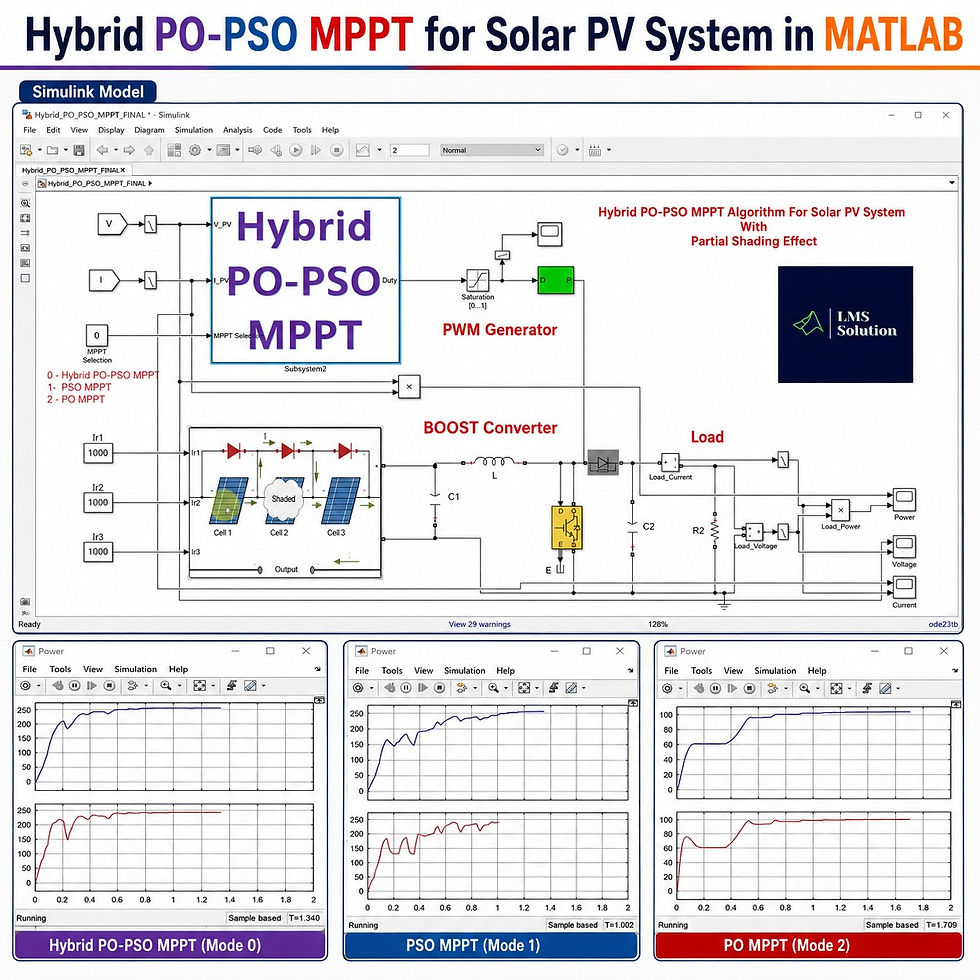
Under partial shading, the PV power characteristic can contain multiple power peaks. This makes conventional MPPT techniques less effective because the controller may settle at a local maximum instead of identifying the global maximum power point.
The Hybrid PO-PSO MPPT for Solar PV System combines:
PO MPPT for simple and fast local tracking.
PSO MPPT for global maximum power point searching.
A hybrid PO-PSO strategy to improve tracking speed while maintaining global-search capability.
A boost converter for extracting and transferring the maximum available PV power.
MATLAB/Simulink implementation for performance comparison under normal irradiance and partial shading.
The developed model can operate using three different MPPT modes, allowing PO, PSO, and Hybrid PO-PSO algorithms to be evaluated using the same solar PV system.
𝐖𝐡𝐲 𝐇𝐲𝐛𝐫𝐢𝐝 𝐏𝐎-𝐏𝐒𝐎 𝐌𝐏𝐏𝐓?
Both PO and PSO have useful characteristics, but they also have limitations when used independently.
MPPT Method | Main Advantage | Main Limitation |
PO MPPT | Simple operation and straightforward implementation | May identify the first local maximum under partial shading |
PSO MPPT | Capable of searching for the global maximum power point | Tracking may require more time depending on the search process |
Hybrid PO-PSO MPPT | Combines fast tracking with global-search capability | Requires combined PO-PSO control logic |
The hybrid technique is therefore designed to provide:
Faster maximum power point identification.
Improved operation during partial shading.
Better global maximum power point tracking.
Reduced tracking time compared with the individual PO and PSO methods.
𝐒𝐲𝐬𝐭𝐞𝐦 𝐎𝐯𝐞𝐫𝐯𝐢𝐞𝐰
The MATLAB/Simulink model consists of the following major sections:
Solar PV system
Irradiance inputs
PV voltage measurement
PV current measurement
Hybrid PO-PSO MPPT controller
MPPT mode-selection block
PWM generator
Boost converter
DC load
Power, voltage, and current measurement scopes
The overall power flow is:
Solar PV Array → Boost Converter → DC Load
The MPPT controller continuously uses the PV voltage and PV current to determine the required converter control signal.
𝐒𝐨𝐥𝐚𝐫 𝐏𝐕 𝐂𝐨𝐧𝐟𝐢𝐠𝐮𝐫𝐚𝐭𝐢𝐨𝐧
The PV model contains three series-connected sections so that different irradiance levels can be applied to create partial shading conditions.
Parameter | Value |
PV sections | 3 |
Total PV cells | 60 |
Section 1 | Cells 1–20 |
Section 2 | Cells 21–40 |
Section 3 | Cells 41–60 |
Total rated PV power | Approximately 250 W |
PV temperature | 25 °C |
Irradiance inputs | Ir1, Ir2, Ir3 |
Each section receives an independent irradiance input.
This arrangement allows the system to be tested under both:
Uniform irradiance
Partial shading conditions
𝐖𝐨𝐫𝐤𝐢𝐧𝐠 𝐏𝐫𝐨𝐜𝐞𝐬𝐬
The operation of the system can be summarized in a few steps.
1. PV Power Generation
The solar PV system generates DC voltage and current according to the applied irradiance.
Three separate irradiance inputs are provided for the PV sections.
2. Voltage and Current Measurement
The model measures:
PV voltage
PV current
These two signals are supplied to the MPPT controller.
3. MPPT Processing
Depending on the selected operating mode, the controller executes:
Hybrid PO-PSO MPPT
PSO MPPT
PO MPPT
4. Duty-Cycle Generation
The selected MPPT algorithm determines the required duty cycle.
5. PWM Generation
The duty-cycle signal is processed by the PWM generator.
6. Boost Converter Control
The generated switching pulse controls the semiconductor switch of the boost converter.
The converter adjusts the PV operating point so that maximum available solar power can be extracted.
7. Load Power Delivery
The resulting power is delivered to the DC load while voltage, current, and power are monitored through simulation scopes.
𝐌𝐏𝐏𝐓 𝐎𝐩𝐞𝐫𝐚𝐭𝐢𝐧𝐠 𝐌𝐨𝐝𝐞𝐬
A constant selection block is provided in the Simulink model to select the required MPPT algorithm.
Selection Value | Operating Mode |
0 | Hybrid PO-PSO MPPT |
1 | PSO MPPT |
2 | PO MPPT |
This makes it easy to compare all three algorithms without changing the main PV or converter configuration.
𝐂𝐨𝐧𝐭𝐫𝐨𝐥 𝐒𝐭𝐫𝐚𝐭𝐞𝐠𝐲
𝐏𝐎 𝐌𝐏𝐏𝐓
The PO controller tracks the PV operating point by observing changes in PV power.
Its main benefits are:
Simple control structure.
Easy implementation.
Suitable for normal irradiance conditions.
However, during partial shading, several local power peaks may appear.
According to the demonstrated model, PO can settle around a local maximum before identifying the actual global maximum power point.
𝐏𝐒𝐎 𝐌𝐏𝐏𝐓
PSO stands for Particle Swarm Optimization.
The PSO controller uses a population-based search mechanism to locate a suitable operating point.
Its advantages include:
Global searching capability.
Better suitability for partial shading.
Ability to identify a higher-power operating region.
A drawback is that the searching process can take additional time, particularly when more candidate operating points are involved.
𝐇𝐲𝐛𝐫𝐢𝐝 𝐏𝐎-𝐏𝐒𝐎 𝐌𝐏𝐏𝐓
The proposed hybrid approach combines the useful characteristics of both methods.
The objective is to achieve:
Rapid tracking.
Global maximum power identification.
Improved partial-shading performance.
Reduced tracking delay.
Better overall PV utilization.
In the demonstrated simulation, the hybrid method reaches the maximum power point faster than the individual PO and PSO methods.
𝐁𝐨𝐨𝐬𝐭 𝐂𝐨𝐧𝐯𝐞𝐫𝐭𝐞𝐫 𝐎𝐩𝐞𝐫𝐚𝐭𝐢𝐨𝐧
The solar PV array is connected to a DC-DC boost converter.
The converter includes the main power-stage components required for controlling the PV operating point.
The MPPT controller does not directly change the PV panel. Instead, it changes the converter duty cycle.
The boost converter therefore acts as the interface between:
Solar PV system
MPPT controller
DC load
The PWM signal generated from the MPPT output controls the boost-converter switching device.
𝐌𝐞𝐚𝐬𝐮𝐫𝐞𝐝 𝐎𝐮𝐭𝐩𝐮𝐭𝐬
Three main sets of signals are observed in the simulation.
Scope | Measurements |
Power Scope | PV power and load power |
Voltage Scope | PV voltage and load voltage |
Current Scope | PV current and load current |
These signals help evaluate both the MPPT response and the operation of the power converter.
𝐒𝐢𝐦𝐮𝐥𝐚𝐭𝐢𝐨𝐧 𝐂𝐚𝐬𝐞 𝟏: 𝐍𝐨𝐫𝐦𝐚𝐥 𝐈𝐫𝐫𝐚𝐝𝐢𝐚𝐧𝐜𝐞
For the first simulation condition, all three PV sections receive the same irradiance.
PV Section | Irradiance |
Section 1 | 1000 W/m² |
Section 2 | 1000 W/m² |
Section 3 | 1000 W/m² |
Temperature | 25 °C |
Under this condition, the PV system produces approximately:
250 W maximum power
The three algorithms were tested separately.
𝐓𝐫𝐚𝐜𝐤𝐢𝐧𝐠 𝐓𝐢𝐦𝐞 𝐂𝐨𝐦𝐩𝐚𝐫𝐢𝐬𝐨𝐧
MPPT Algorithm | Approximate Tracking Time |
Hybrid PO-PSO | 0.8 s |
PSO | 1.2 s |
PO | 1.3 s |
The simulation therefore shows a clear tracking-speed improvement with the hybrid controller.
Main Observation
Hybrid PO-PSO reaches the maximum power region faster than both PSO and PO under uniform irradiance.
𝐒𝐢𝐦𝐮𝐥𝐚𝐭𝐢𝐨𝐧 𝐂𝐚𝐬𝐞 𝟐: 𝐏𝐚𝐫𝐭𝐢𝐚𝐥 𝐒𝐡𝐚𝐝𝐢𝐧𝐠
The second condition introduces unequal irradiance across the three PV sections.
PV Section | Irradiance |
Section 1 | 1000 W/m² |
Section 2 | 600 W/m² |
Section 3 | 300 W/m² |
Temperature | 25 °C |
Under this partial-shading condition, the demonstrated maximum power is approximately:
113 W
Again, the three MPPT techniques are tested separately.
𝐏𝐚𝐫𝐭𝐢𝐚𝐥-𝐒𝐡𝐚𝐝𝐢𝐧𝐠 𝐓𝐫𝐚𝐜𝐤𝐢𝐧𝐠 𝐂𝐨𝐦𝐩𝐚𝐫𝐢𝐬𝐨𝐧
MPPT Algorithm | Approximate Tracking Time |
Hybrid PO-PSO | 0.8 s |
PSO | 1.1 s |
PO | 1.3 s |
The hybrid controller again provides the quickest response among the three methods in the demonstrated simulation.
𝐏𝐞𝐫𝐟𝐨𝐫𝐦𝐚𝐧𝐜𝐞 𝐂𝐨𝐦𝐩𝐚𝐫𝐢𝐬𝐨𝐧
Condition | Hybrid PO-PSO | PSO | PO |
Uniform irradiance tracking time | 0.8 s | 1.2 s | 1.3 s |
Partial shading tracking time | 0.8 s | 1.1 s | 1.3 s |
Global-search capability | High | High | Limited under partial shading |
Tracking speed in demonstrated model | Fastest | Moderate | Slower |
Partial-shading suitability | Very good | Good | Limited |
The results indicate that combining PO and PSO can improve the dynamic MPPT response while retaining the global-search capability needed under partial shading.
𝐊𝐞𝐲 𝐅𝐞𝐚𝐭𝐮𝐫𝐞𝐬
Three selectable MPPT algorithms in a single Simulink model.
Hybrid PO-PSO control for improved tracking.
Operation under both normal and partial shading conditions.
Three independently adjustable PV irradiance inputs.
Approximately 250 W rated PV system.
25 °C PV operating temperature in the demonstrated tests.
Boost-converter-based maximum power extraction.
PWM switching control.
Measurement of PV and load power.
Measurement of PV and load voltage.
Measurement of PV and load current.
Easy comparison of PO, PSO, and Hybrid PO-PSO performance.
Useful platform for understanding global maximum power point tracking.
𝐀𝐝𝐯𝐚𝐧𝐭𝐚𝐠𝐞𝐬 𝐨𝐟 𝐇𝐲𝐛𝐫𝐢𝐝 𝐏𝐎-𝐏𝐒𝐎 𝐌𝐏𝐏𝐓
The simulation highlights several useful advantages:
Faster tracking of the maximum power point.
Better operation during partial shading.
Improved global maximum power point identification.
Reduced dependence on the limitations of a single MPPT technique.
Improved utilization of available solar power.
Suitable for studying rapidly changing PV operating conditions.
Direct comparison with conventional PO and PSO controllers.
𝐀𝐩𝐩𝐥𝐢𝐜𝐚𝐭𝐢𝐨𝐧𝐬
Hybrid PO-PSO MPPT concepts can be useful in solar-energy systems where irradiance is not always uniform, including:
Rooftop solar PV installations.
Building-integrated photovoltaic systems.
Solar PV systems affected by nearby structures.
PV arrays exposed to moving cloud conditions.
Standalone DC solar systems.
Solar battery charging systems.
DC microgrids.
Renewable-energy conversion systems.
PV-fed DC loads.
Research on intelligent MPPT techniques.
Comparative studies of optimization-based MPPT controllers.
𝐖𝐡𝐨 𝐂𝐚𝐧 𝐔𝐬𝐞 𝐓𝐡𝐢𝐬 𝐌𝐨𝐝𝐞𝐥?
The model is especially useful for:
Engineering students learning solar PV control.
Researchers studying partial-shading MPPT.
Engineers working with DC-DC power converters.
MATLAB/Simulink learners.
Renewable-energy researchers.
Researchers comparing conventional and optimization-based MPPT techniques.
It provides a practical way to observe how different controllers respond to exactly the same PV operating conditions.
𝐒𝐢𝐦𝐮𝐥𝐚𝐭𝐢𝐨𝐧 𝐒𝐮𝐦𝐦𝐚𝐫𝐲
Item | Demonstrated Value |
Simulation platform | MATLAB/Simulink |
PV rating | Approximately 250 W |
Number of PV sections | 3 |
Total cells | 60 |
Temperature | 25 °C |
MPPT Mode 0 | Hybrid PO-PSO |
MPPT Mode 1 | PSO |
MPPT Mode 2 | PO |
Uniform irradiance | 1000 / 1000 / 1000 W/m² |
Uniform-condition maximum power | Approximately 250 W |
Partial-shading irradiance | 1000 / 600 / 300 W/m² |
Partial-shading maximum power | Approximately 113 W |
Hybrid tracking time | Approximately 0.8 s |
Converter | Boost converter |
Controller inputs | PV voltage and PV current |
𝐂𝐨𝐧𝐜𝐥𝐮𝐬𝐢𝐨𝐧
The Hybrid PO-PSO MPPT for Solar PV System in MATLAB/Simulink provides an effective approach for maximum power extraction under both uniform irradiance and partial shading.
The simulation comparison demonstrates that:
PO provides simple MPPT operation but can face difficulties in locating the global maximum during partial shading.
PSO improves global-search capability but requires additional tracking time.
Hybrid PO-PSO combines the advantages of both techniques.
In the demonstrated tests, Hybrid PO-PSO reaches the maximum power point in approximately 0.8 seconds, compared with about 1.1–1.2 seconds for PSO and 1.3 seconds for PO, depending on the irradiance condition.
The model therefore offers a useful MATLAB/Simulink platform for understanding hybrid MPPT control, partial-shading behavior, boost-converter control, and global maximum power point tracking in solar photovoltaic systems.


Comments