


Fuzzy MPPT Based Wind Energy Conversion System Using MATLAB/Simulink

Introduction
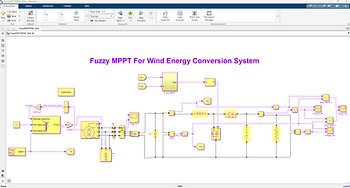
Fuzzy MPPT wind energy system
Wind energy is one of the most important renewable energy sources used for clean and sustainable power generation. However, the output power of a wind energy system depends mainly on wind speed, turbine characteristics, generator performance, and power electronic converter control. Since wind speed changes continuously, an efficient control technique is required to extract maximum power from the wind turbine.
In this blog post, a Fuzzy MPPT based Wind Energy Conversion System is discussed using MATLAB/Simulink. The proposed system includes a wind turbine, generator, rectifier, boost converter, and fuzzy logic based MPPT controller. The main objective of this simulation is to improve power extraction from the wind source under variable wind speed conditions.
System Configuration
The complete Simulink model consists of a wind turbine connected to a generator. The generator produces AC output voltage and current based on the mechanical power obtained from the wind turbine. This AC output is converted into DC using a rectifier. After rectification, a boost converter is used to step up the DC voltage to the required level.
The fuzzy MPPT controller receives the rectifier voltage and rectifier current as input signals. Based on these input parameters, the controller generates a suitable duty cycle for the boost converter. By adjusting the duty cycle, the converter helps the wind system operate near the maximum power point.
Working of Fuzzy MPPT Controller
The fuzzy MPPT controller is used to track the maximum available power from the wind energy system. Compared with conventional MPPT techniques, fuzzy logic control provides better dynamic performance under changing wind conditions. It does not require an exact mathematical model of the system and can handle nonlinear variations effectively.
In this system, the controller continuously monitors the voltage and current from the rectifier side. When wind speed changes, the generated power also changes. The fuzzy controller responds to this variation and adjusts the boost converter duty cycle to maintain maximum power extraction.
Simulation Condition
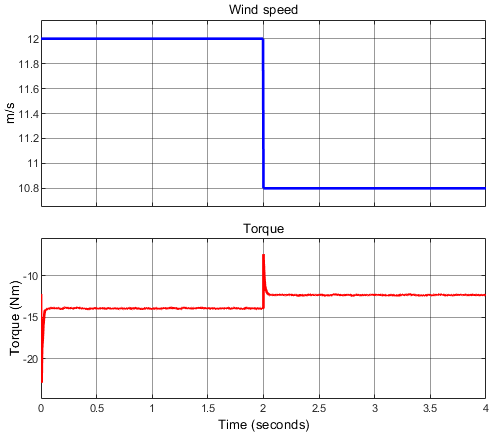
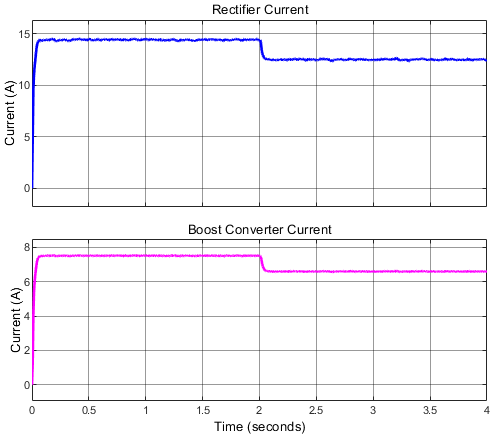
The simulation is tested under variable wind speed conditions. Initially, the wind speed is maintained at 12 m/s. At 2 seconds, the wind speed is reduced to 10.8 m/s. Due to this change, turbine torque, generator voltage, generator current, rectifier voltage, boost converter voltage, current, and power also vary.
This test condition helps to analyze the dynamic response of the fuzzy MPPT controller during wind speed variation.
Result Analysis
The wind speed and torque waveform show that the turbine responds properly when the wind speed changes from 12 m/s to 10.8 m/s. A small transient is observed at the time of wind speed change, after which the torque settles to a stable value.
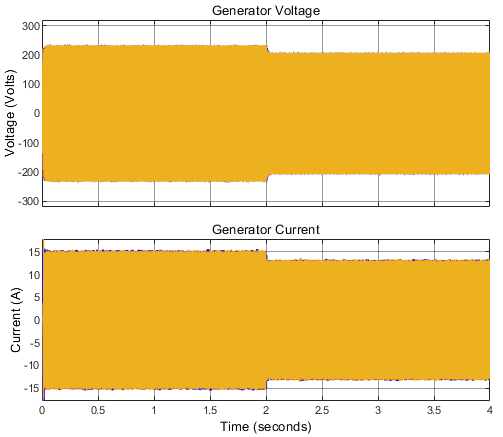
The generator voltage and current waveforms confirm that the generator output depends directly on the wind input. At higher wind speed, the generator produces higher voltage and current. After the wind speed reduction, both voltage and current decrease smoothly.
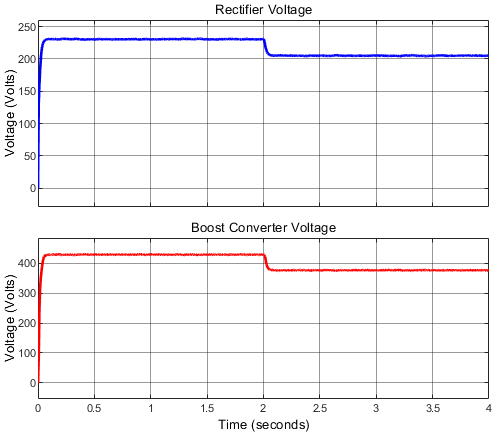
The rectifier output voltage initially remains around 230 V and decreases after the wind speed is reduced. The boost converter successfully increases the DC voltage to around 420 V during the initial condition and settles near 380 V after the wind speed reduction.
The current waveform also follows the same operating pattern. The rectifier and boost converter currents decrease after the reduction in wind speed, indicating that the system adjusts its output according to the available wind power.
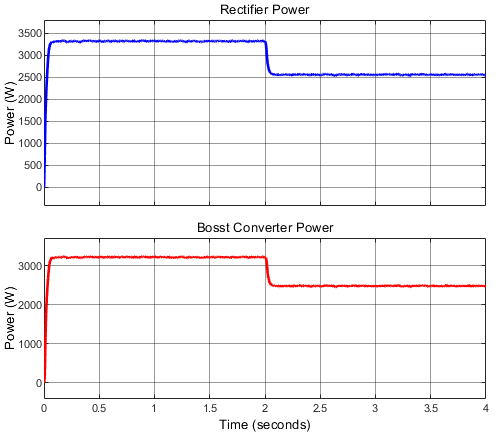
The power waveform clearly shows the performance of the MPPT controller. Initially, the boost converter power reaches nearly 3.1 kW. After the wind speed decreases, the output power settles around 2.5 kW. This confirms that the fuzzy MPPT controller tracks the maximum available power under changing wind conditions.
Advantages of the Proposed System
The fuzzy MPPT based wind energy conversion system provides improved power tracking performance. It offers smooth dynamic response during wind speed variation and helps maintain stable converter output. The use of a boost converter improves the DC voltage level, making the system suitable for further DC link or grid-connected applications.
The main advantages include:
· Effective maximum power extraction from wind energy
· Smooth response under variable wind speed
· Improved DC voltage regulation using boost converter
· Reduced dependency on exact mathematical modeling
· Suitable for renewable energy simulation and research applications
Conclusion
The MATLAB/Simulink simulation of the Fuzzy MPPT based Wind Energy Conversion System verifies the effectiveness of intelligent MPPT control for wind power applications. The results show that the system responds properly when wind speed changes from 12 m/s to 10.8 m/s. The voltage, current, torque, and power waveforms confirm stable operation of the generator, rectifier, boost converter, and fuzzy MPPT controller.
Overall, the fuzzy MPPT controller improves the power extraction capability of the wind energy system and ensures better performance under dynamic wind conditions.
Keywords
Fuzzy MPPT wind energy system, MATLAB Simulink wind turbine model, wind energy conversion system, fuzzy logic MPPT controller, boost converter wind energy system, rectifier boost converter Simulink, wind turbine generator simulation, renewable energy MATLAB project, MPPT control for wind turbine, wind power generation simulation


Comments